
high-rise condominium security systems • Northwest Florida

High-rise condominium security engineered as infrastructure.

Connect entrances, elevators, parking, pools, beach access and remote investigation across long vertical pathways and occupied spaces.

Direct answer

What is different about security systems for high-rise condominiums?

A high-rise condominium security system must connect entrances, elevators, garages, amenities, rooftops and occupied floors through long vertical pathways. Cameras, access control, fiber, recording, power resilience and response procedures must operate as one maintainable infrastructure plan.

Field-informed guidance from Cybersmetrics • 16+ years in security integration • Updated September 22, 2026

Integrated architecture

Four systems that must operate as one plan.

Strong security connects evidence, access, infrastructure and operating responsibility. It does not leave the property with unrelated products and separate failure points.

01

Enterprise video and evidence

Separate identification, overview, PTZ, vehicle and elevator views, then validate recorded results in real lighting.

02

Fiber and vertical pathways

Engineer risers, telecom rooms, rooftop links, PoE capacity and electrical isolation for long-distance serviceability.

03

Elevator and access integration

Coordinate video, two-way communications, credentials, intercoms and approved elevator interfaces.

04

Coastal resilience

Address corrosion, wind, lightning, utility disturbances, heat and post-storm inspection as design requirements.

Property-zone planning

Match every zone to an operating result.

A device list is not a design. Each area needs a clear evidence, access or resilience objective and a measurable acceptance method.

Property zoneRequired objectiveScope and acceptance
Lobby and elevator transitionsIdentify movement between public and controlled areasDedicated identification and overview views, access-event coordination and crowd-condition testing
Garage and vehicle entrancesExplain vehicle movement and recover plate evidence when requiredSeparate overview and LPR views, lighting analysis, lane testing and searchable retention
Pools, beach and amenitiesDocument access disputes and safety-sensitive eventsPrivacy-aware transition coverage, appropriate credentials and defined incident response
Risers, rooftops and telecom roomsKeep systems connected and serviceableFiber, managed PoE, UPS, surge protection, labeling, diagrams and environmental protection

High-rise field experience

The visible camera is only the edge of the condominium system.

Usable video depends on the complete path from the rooftop or garage through fiber, managed switching, recording, storage, power protection and the operator's investigation workflow.

View the Shores of Panama project
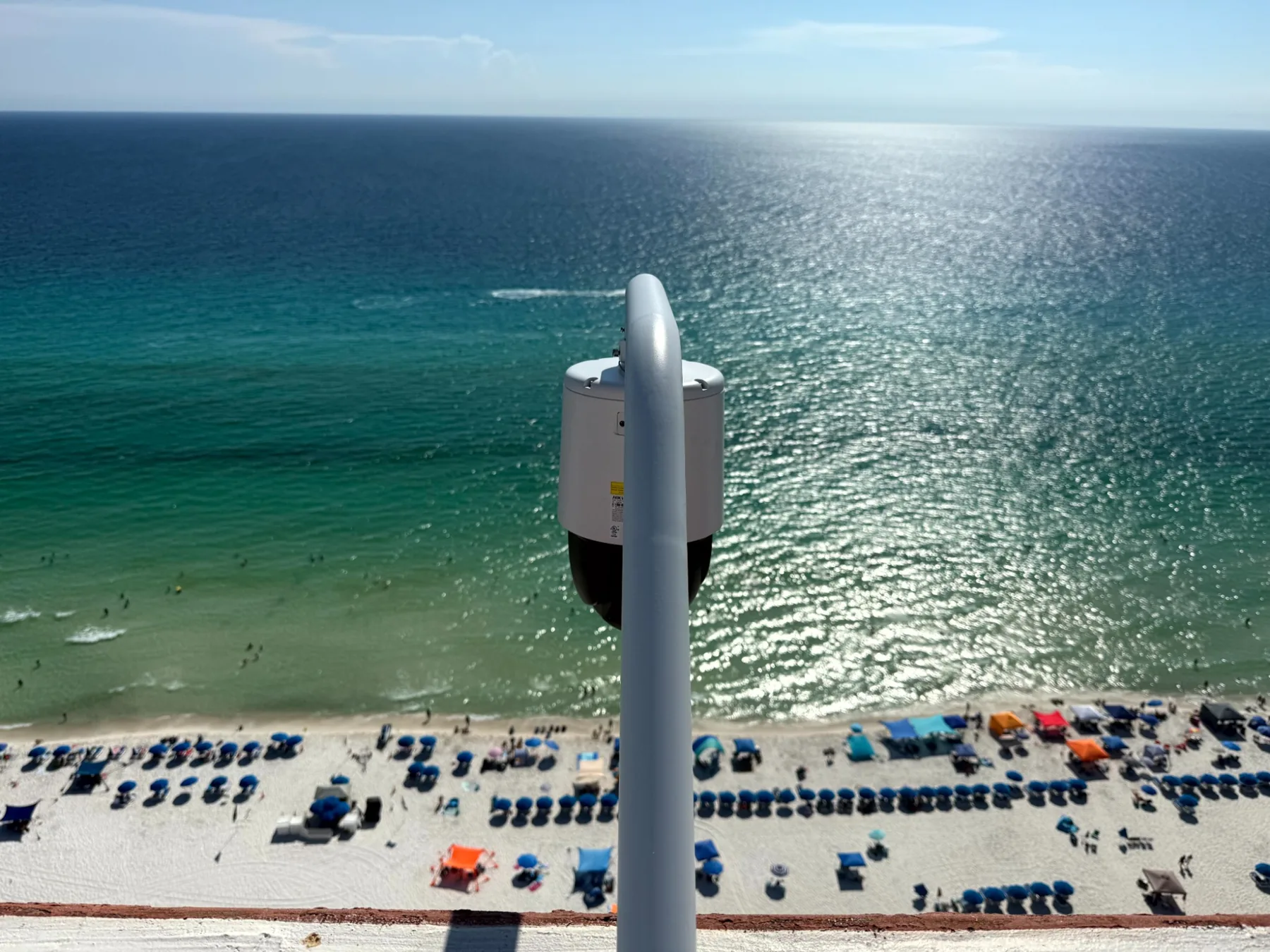
PTZ security camera installed on a Gulf-front high-rise condominiumField experience • documented planning

Buyer decisions

What to settle before requesting proposals.

Clear requirements produce better proposals, fewer exclusions and a more defensible board or management decision.

01

Treat infrastructure as scope

Fiber, pathways, switching, storage and power cannot remain unspecified allowances behind a camera proposal.

02

Preserve useful assets deliberately

Reuse supported cameras or pathways only after compatibility, condition, capacity and cybersecurity are verified.

03

Plan around occupied operations

Define access, noise, lift, shutdown, resident notice and cutover requirements before construction begins.

A defensible path

From unknown condition to accountable operation.

01

Survey

Map entrances, elevators, garages, amenities, risers, telecom spaces, evidence gaps and current failures.

02

Engineer

Calculate camera performance, fiber, PoE, bandwidth, storage, access hardware, power and integrations.

03

Phase

Separate immediate reliability work, evidence priorities and long-term modernization around the capital plan.

04

Commission

Test day/night evidence, retention, access events, elevator communications, failover and owner documentation.

Condominiums & High-Rises security FAQ

Direct answers for owners, boards and managers.

Use these questions to challenge a design, compare proposals and define the next responsible step.

Why is fiber important in a high-rise security system?+

Fiber supports long distances, high bandwidth and electrical isolation between distribution points. It is often the practical backbone for cameras, access control and elevator-connected technology across tall or multi-building properties.

Can elevators be integrated with security?+

Yes. Depending on approved interfaces, video, two-way audio, floor or direction data, access permissions, analytics and LED messaging can operate as a coordinated elevator technology layer.

What should a condominium security assessment include?+

It should document camera evidence, night performance, recording and retention, access workflows, gates, fiber, networks, power resilience, administrator ownership and lifecycle priorities.

How many security cameras does a high-rise condominium need?+

There is no responsible camera-per-floor formula. The count follows defined evidence objectives at entrances, elevators, garages, amenities, service areas and other incident locations after distance, lighting and infrastructure are verified.

Can a condominium camera system be modernized without replacing everything?+

Often, yes. Supported cameras, fiber, pathways and switching may be reusable when condition, compatibility, capacity and cybersecurity are verified. A phased plan should prioritize unreliable recording and evidence-critical views first.

Start with verified conditions

Turn high-rise security into one supportable infrastructure plan.

Request consultation ↗