
Detect
Is a person or vehicle present in the protected area?
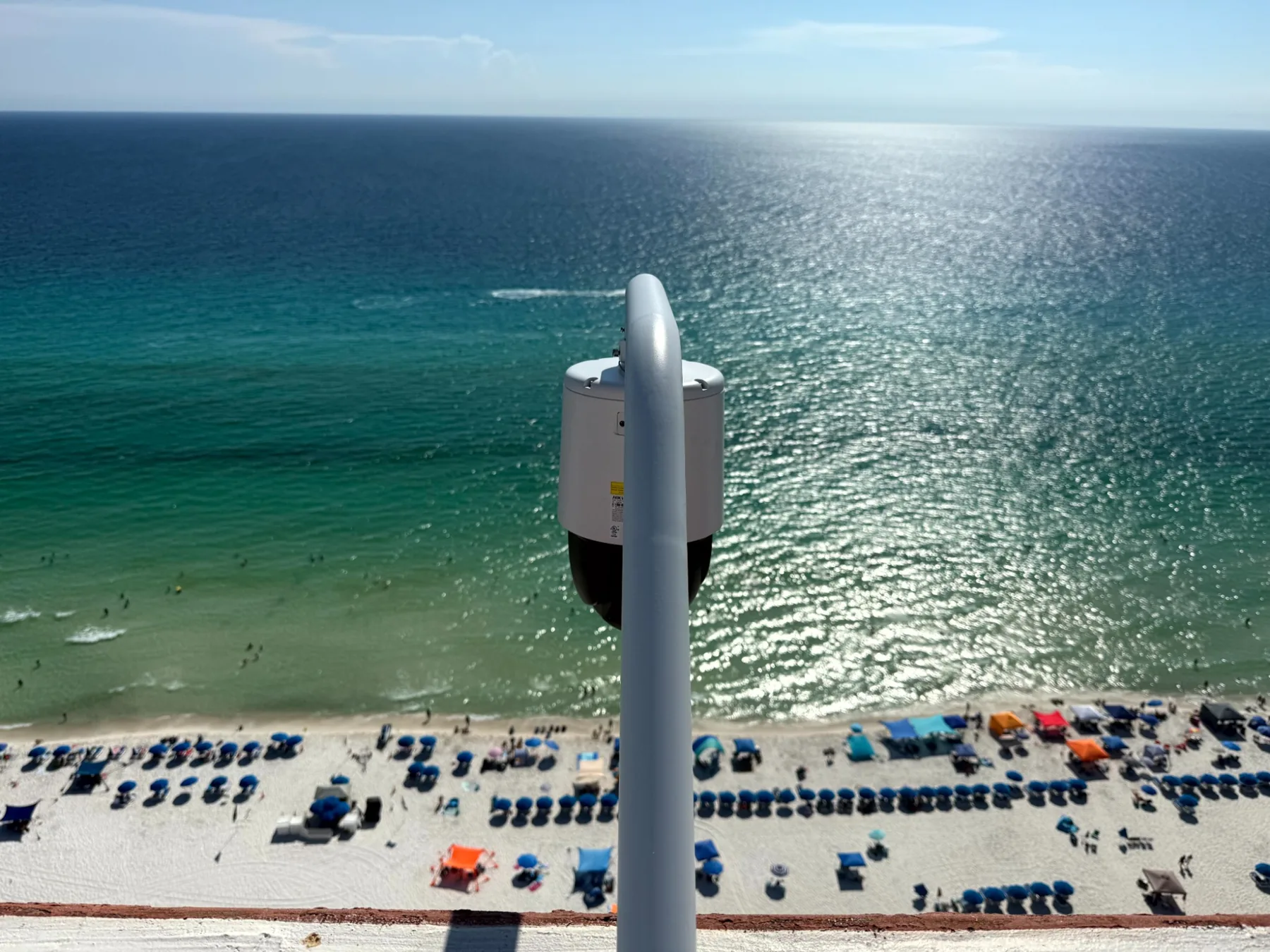
Commercial video surveillance • Northwest Florida
Modern IP cameras, AI analytics, LPR, PTZ, multisensor coverage, storage and video management—engineered for condominiums, HOAs, resorts, businesses and demanding coastal properties.
The direct answer
A good system consistently produces usable evidence and actionable alerts under the property’s real conditions. It is not defined by camera count, 4K labels or AI marketing.
Modern systems increasingly process AI at the camera, combine local and cloud management, use multisensor cameras to reduce blind spots, and search video through object metadata. But the fundamentals remain unforgiving: the right lens, sufficient pixels on target, controlled motion, difficult lighting, reliable network capacity, calculated storage and a trained operating team.
Design from the threat backward
“Cover the parking lot” is not a design requirement. Decide what the camera must prove, where the target will be and under which conditions.
Is a person or vehicle present in the protected area?
What is happening, how many subjects are involved and where are they moving?
Is this the same known person, vehicle or object seen earlier?
Is the captured detail sufficient to establish identity or a defining feature?
Can the system consistently capture a license plate, label, number or other required text?
Will an alert reach the correct person with enough context and time to act?
Real system layers
Field devices, vehicle evidence and the recording network must be engineered as one serviceable environment.
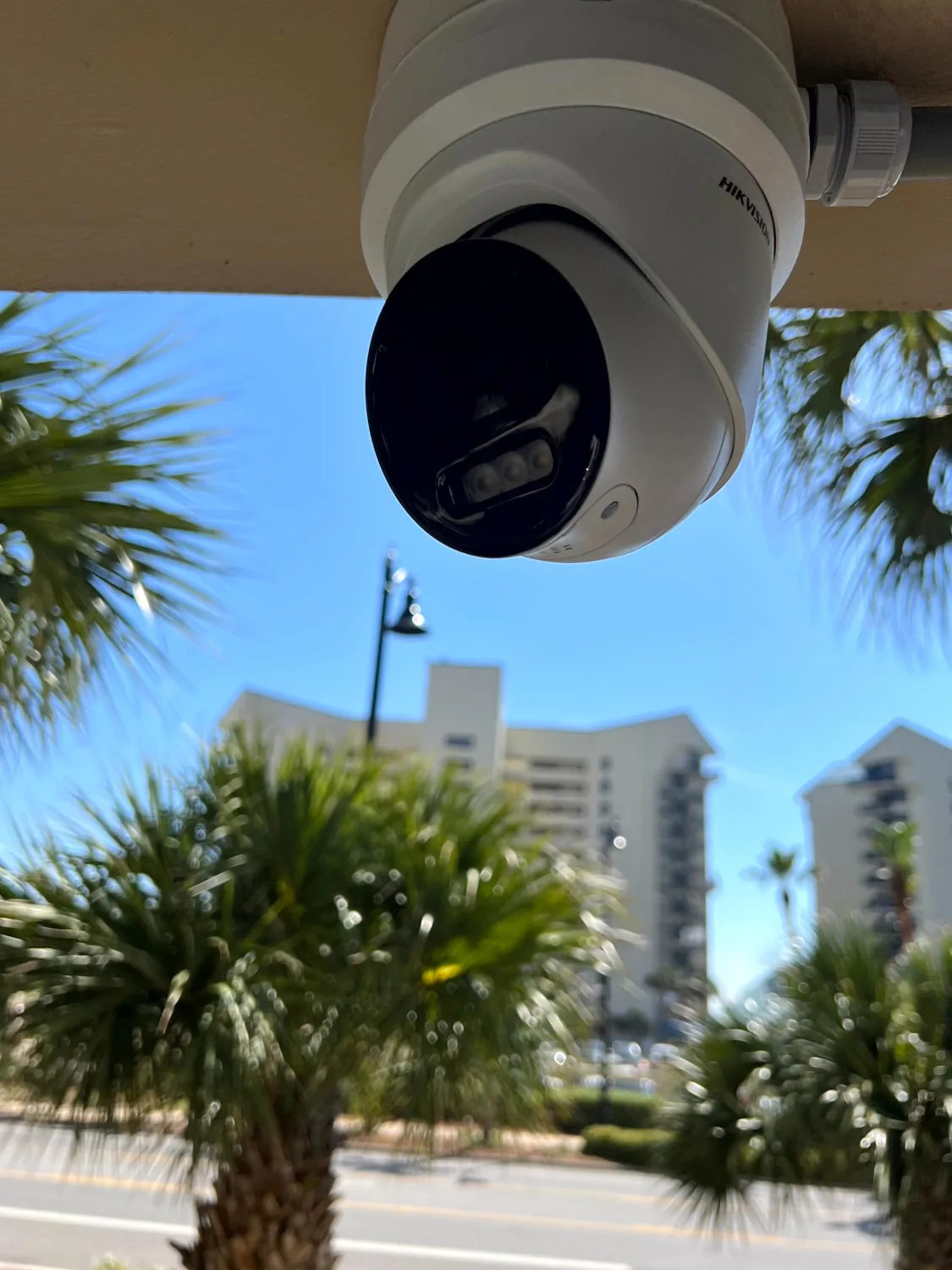
Continuous coverage is planned around distance, angle, lighting, motion and the detail the property must retain.
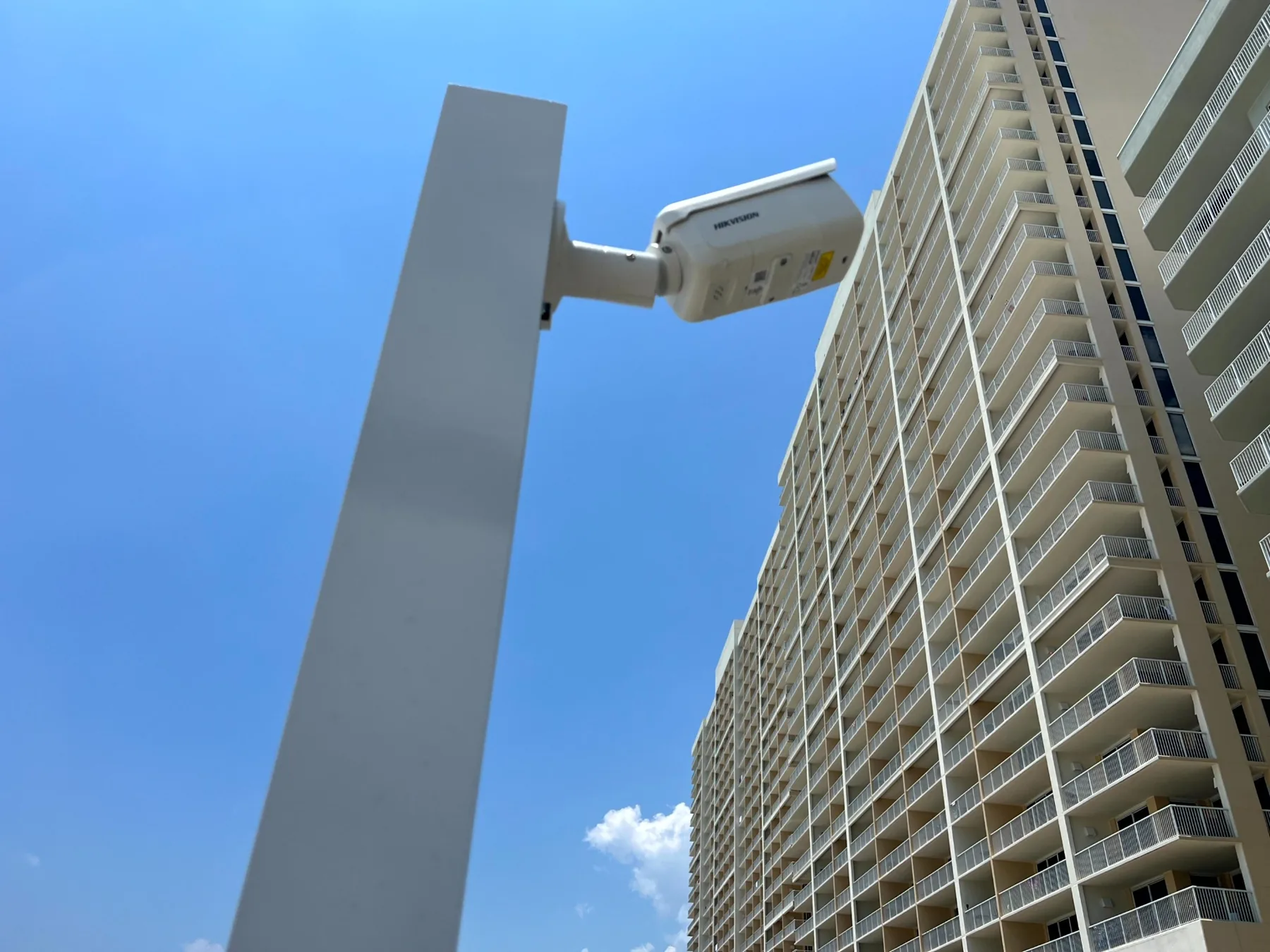
Dedicated LPR and overview cameras separate plate capture from the wider story around a vehicle.
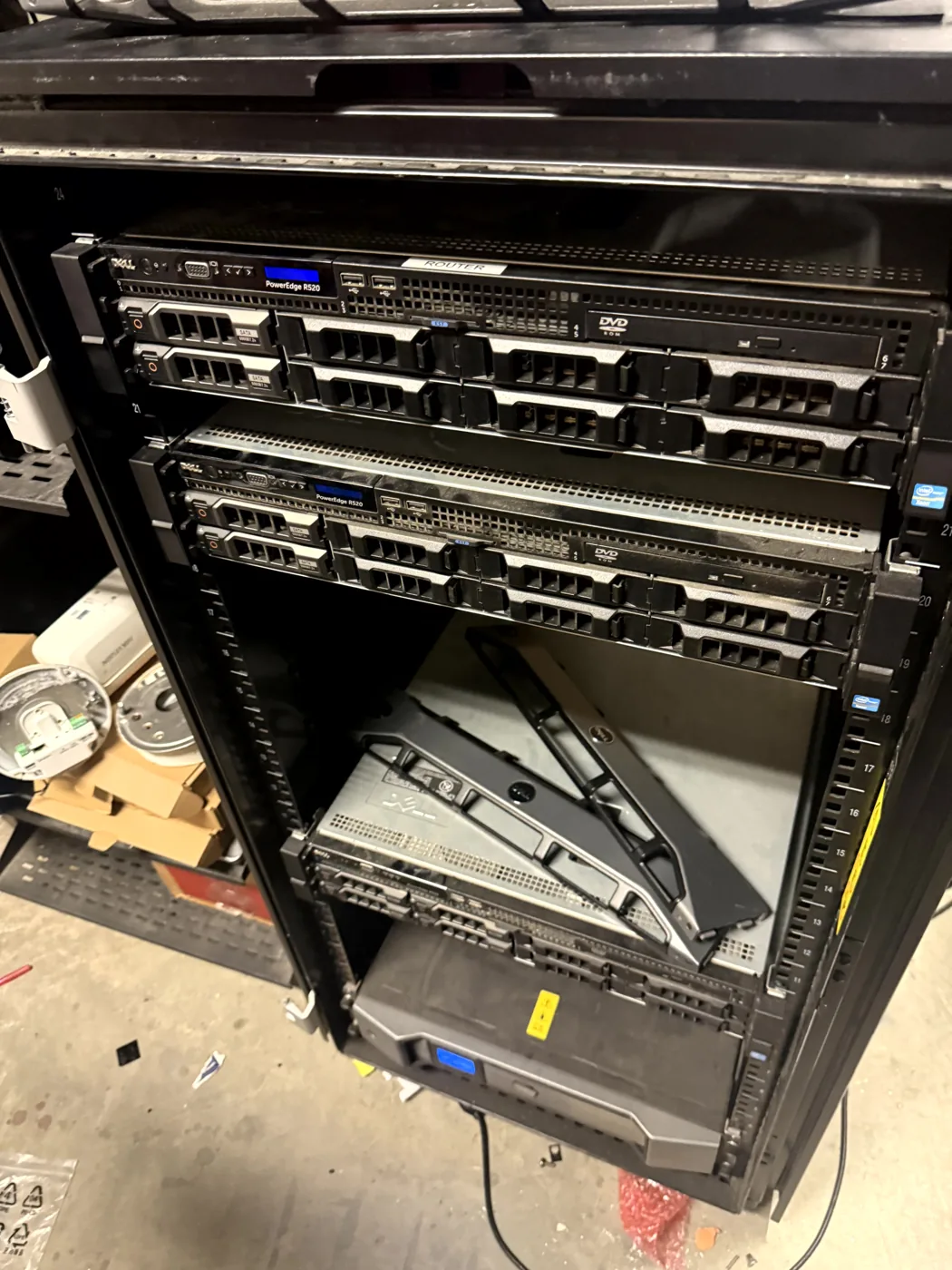
Managed PoE, fiber, storage, UPS, health alerts and documentation keep evidence available after installation day.
Choose the correct camera type
A dome, bullet, PTZ, multisensor, fisheye, LPR and thermal camera are not interchangeable—even when the resolution number is identical.
Captures a usable face or other defining detail at a controlled point. Lens, distance, angle, lighting and motion matter more than a generic megapixel claim.
Provides situational context across a lobby, hallway, parking area or amenity. It should not be expected to identify everyone anywhere in the scene.
Supports a defined distant target with a tighter field of view, appropriate focal length, IR and mounting stability.
Lets an operator investigate and follow activity over a wide area. Presets, tours and auto-tracking help, but a PTZ can still be looking the wrong direction.
Uses multiple sensors from one mounting point to cover several directions continuously—valuable for corners, garages, roofs and intersections.
Provides panoramic coverage and dewarped views from a central point. Excellent for context, but mounting height and edge detail must be evaluated.
Uses controlled lane geometry, shutter, exposure and illumination to capture license plates. It should be separate from general overview video when evidence matters.
Detects heat contrast for perimeter awareness and difficult lighting. Thermal is excellent for detection but usually needs visible video for identity and context.
Modern camera brands and platforms
Cybersmetrics is manufacturer-independent. Product families evolve quickly, so final models, firmware, licensing, compliance and compatibility are verified before procurement.
Often considered for: Enterprise, government, education, commercial and complex sites prioritizing imaging, cybersecurity, analytics and broad VMS support
ARTPEC-9 cameras add accelerated edge analytics, improved imaging and newer encoding capabilities. Current P32 and Q-series models bring AI object analytics into fixed and PTZ applications.
Design check: Match the exact series, lens, sensor and environmental rating to the scene; the Axis name alone does not guarantee identification detail.
Review official manufacturer information ↗Often considered for: Commercial, enterprise, government and high-coverage applications needing strong AI and multisensor choices
Wisenet 9 is Hanwha Vision’s current proprietary system-on-chip platform, using dual NPU architecture for AI analytics and image optimization. Newer models include advanced multi-directional and ruggedized PTZ options.
Design check: Confirm the individual model’s country-of-origin, compliance, analytics licenses, lens ranges and VMS support for the actual procurement requirement.
Review official manufacturer information ↗Often considered for: Security-conscious organizations seeking edge AI, open integration and a broad camera range
i-PRO introduced X-Series fisheye cameras with generative AI at the edge for real-time detection and alerts in 2026, adding natural-language-oriented intelligence without relying entirely on cloud analytics.
Design check: Generative or specialized AI must be tested against real scenes. It does not replace correct pixels, shutter, lighting, placement or operator procedures.
Review official manufacturer information ↗Often considered for: Organizations seeking tightly integrated cameras, AI analytics, VMS, cloud connectivity and enterprise investigation tools
Current H6A cameras combine AI-powered video and audio analytics, while AI NVR 2 can extend analytics to supported non-analytic and third-party cameras in Unity deployments.
Design check: Choose between Alta and Unity architectures deliberately; cloud management, on-premise recording, camera compatibility and recurring costs differ.
Review official manufacturer information ↗Often considered for: Businesses, communities and properties already invested in UniFi networking that want straightforward local recording with remote management
Protect 7.1 expanded AI detection, PTZ vehicle recognition, immersive 360 exports and ONVIF capabilities. Ubiquiti’s 2026 lineup includes newer G6 cameras and next-generation NVR hardware.
Design check: Validate console and recorder capacity, storage redundancy, camera interoperability, evidence workflow and long-term enterprise requirements before standardizing.
Review official manufacturer information ↗Often considered for: Critical, industrial, perimeter, transportation and demanding commercial scenes requiring robust imaging and advanced analytics
The current IVA Pro portfolio provides application-specific analytics for perimeter, traffic, buildings and other environments, while newer work adds deeper contextual scene understanding.
Design check: Advanced analytics require scene-specific configuration and acceptance tests. A feature list is not proof of detection performance at the property.
Review official manufacturer information ↗Brand-independence statement: Listing a manufacturer does not imply partnership, certification or universal endorsement. Suitability is determined by the project’s technical, operational, compliance and lifecycle requirements.
The platform behind the cameras
A Video Management System controls recording, live view, search, maps, permissions, health monitoring, evidence export, integrations and operator workflow.
Omnicast video can operate within a unified platform that also connects access control, ALPR and communications. Often evaluated for complex, multi-system environments.
Official information ↗A broad device ecosystem and product tiers for sites ranging from smaller systems to large deployments. Camera and integration support must be checked against the current device pack.
Official information ↗Avigilon, UniFi Protect, Hanwha and other manufacturers offer tightly integrated recording and management options. These can simplify deployment but require a clear migration and interoperability plan.
Cloud-managed and hybrid video can improve multi-site administration and remote access. Bandwidth, recurring cost, retention, privacy, outage behavior and export time must be calculated.
Image quality is a system
A camera specification can look excellent and still fail at night, during motion or against bright coastal light. We test the entire image chain.
A wide view sees more area but spreads pixels across more scene. Identification often requires a tighter view.
Fast motion needs sufficient shutter speed. Slow exposure can create a bright but unusably blurred face or plate.
Sensor size, optics, IR distance, reflections and scene lighting determine what survives darkness.
Entrances, garages and beachfront scenes often contain bright and dark areas simultaneously. WDR must be tested in place.
Aggressive compression can erase fine detail. Storage calculations must preserve the evidence objective.
Wind, vibration, weak brackets and dirty domes can destroy detail regardless of camera resolution.
AI that earns its place
AI works best when a valid scene, clear objective and responsible response process are designed together.
Filter ordinary motion and focus searches or alerts on relevant objects.
Watch a defined boundary or restricted zone while managing direction, schedule and nuisance sources.
Identify a person or vehicle remaining in a zone beyond a configured time.
Narrow investigations using supported clothing, vehicle or object characteristics; results require human verification.
Follow classified objects while fixed cameras preserve continuous context.
Newer platforms can interpret text-oriented queries or scenes, but must be validated for accuracy, privacy and operational risk.
License plate recognition
Reliable LPR depends on lane width, capture distance, horizontal and vertical angles, target speed, shutter, illumination and plate size in the image. A general parking-lot camera with an “LPR” checkbox is not automatically evidence-grade.
Storage and retention
Camera quantity, codec, resolution, frame rate, complexity, bitrate, recording mode, audio, analytics and redundancy all change the result.
Trees, water, rain, crowds and noise can consume far more data than a quiet indoor hallway.
Event recording can reduce storage but risks losing context if detection, pre-event or post-event settings are weak.
Lower bitrate saves capacity by discarding detail. The retained image still must satisfy the camera’s assigned job.
Usable capacity, RAID behavior, spare drives, rebuild time and recorder limits must be included.
A system is not useful if staff cannot find, validate and export video promptly when an incident occurs.
Offline cameras, failed drives, time drift and recording gaps should generate actionable alerts.
Cybersecurity and procurement
Modern surveillance should use unique credentials, MFA where available, segmented networks, secure remote access, firmware governance, certificate and encryption support, least-privilege roles, protected evidence exports and an asset inventory.
For government, military, grant-funded or otherwise regulated work, verify procurement requirements against authoritative documents. The FCC Covered List includes specified video surveillance equipment and services from covered entities for defined uses, and rebranding does not necessarily change origin.
Review the current FCC Covered List ↗Built for Northwest Florida
Coastal surveillance requires suitable environmental and impact ratings, corrosion-aware hardware, sealed pathways, stable mounts, surge strategy, UPS coverage, fiber where electrical isolation is appropriate and a realistic maintenance plan.
Engineer wind exposure, mounting, vibration, lightning risk, safe service access and pathway integrity.
Manage headlight contrast, low ceilings, conduit damage, long distances and elevator or stair transitions.
Control reflections, privacy, salt deposition, night lighting and changing seasonal activity.
Document shutdown, backup power, remote health, restart sequence and post-storm inspection.
Before approving a camera proposal
Local surveillance design and installation
Cybersmetrics works with condominiums, HOAs, resorts, businesses and controlled facilities throughout the Northwest Florida Gulf Coast.
Free camera planning worksheet
Plan identification, overview, LPR, storage, infrastructure and day/night acceptance before products are selected.
Straight answers
Clear guidance for property managers, condominium boards, business owners and facility stakeholders planning a camera-system investment.
There is no universal best brand. Axis, Hanwha Vision, i-PRO, Avigilon, UniFi Protect and Bosch each offer strong products for different operating models and budgets. The correct selection depends on evidence objective, scene, VMS, cybersecurity, compliance, storage, integrations and long-term support.
No. A 4K sensor can provide more pixels, but image usefulness also depends on lens, distance, shutter speed, sensor quality, compression, bitrate, lighting, angle and motion. A well-designed lower-resolution camera can outperform a poorly placed 4K camera for a specific target.
Camera count should come from coverage objectives, not a unit-per-floor formula. Entrances, elevators, stairs, parking, pools, beach access, loading areas, trash rooms and restricted spaces each require defined evidence outcomes. A site survey and coverage plan are necessary.
Basic motion detection reacts to pixel changes and often produces nuisance events. AI analytics can classify people, vehicles and other objects or behaviors, helping operators search and alert more efficiently. Accuracy still depends on placement, image quality, scene conditions and configuration.
Sometimes at a controlled short-range lane, but dependable systems usually separate the dedicated plate image from an overview image. The plate camera needs exposure settings that can make the surrounding scene dark, especially at night.
A PTZ provides flexible detail and active response, but it records only where it is looking. Fixed or multisensor cameras maintain continuous coverage. Strong designs often combine continuous fixed coverage with a PTZ for investigation.
Retention should follow incident discovery time, operational needs, policy, legal advice and budget. The system must be calculated using actual bitrates, camera count, recording schedules, analytics and redundancy—not a generic days-per-terabyte rule.
Yes. We assess cameras, cabling, fiber, switches, recorders, servers, licenses, storage, power and user workflows. Viable infrastructure can sometimes be retained while unsupported or evidence-limiting components are replaced in phases.
NDAA-related procurement rules restrict certain covered manufacturers and equipment in defined federal contexts. The FCC Covered List and project-specific procurement documents should be checked. A marketing label alone is not sufficient compliance verification.
Locally recorded systems can often continue recording during an internet outage if cameras, network, recorder and power remain operational. Cloud-dependent features and remote viewing may be unavailable. Exact offline behavior must be documented and tested.
Cybersmetrics designs, installs and modernizes commercial video surveillance across Northwest Florida, including Port St. Joe, Mexico Beach, Panama City, Panama City Beach, 30A, Santa Rosa Beach, Miramar Beach, Destin and nearby communities.
Test daytime, nighttime, backlight, rain, motion, identification targets, plate capture, analytics, exports, user permissions, storage retention, failover, power recovery, time synchronization and system-health alerts. Acceptance should prove outcomes, not merely that cameras appear online.
Start with evidence