
Automatic Gates & Operators guide
What should an automatic gate maintenance visit include?
A practical automatic-gate maintenance guide covering mechanics, safety devices, loops, controls, access integration, batteries and documentation.
Direct answer
The safe starting point.
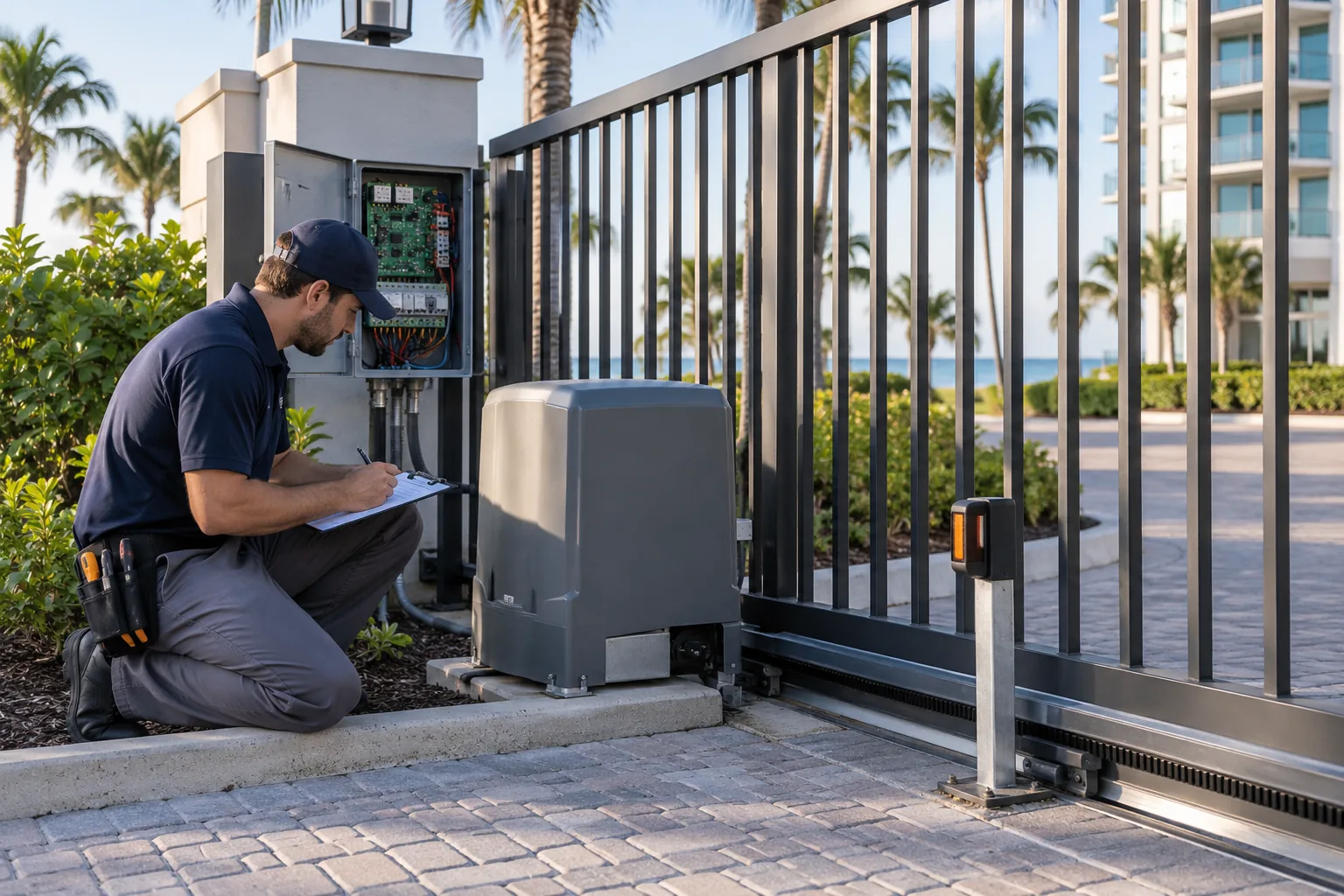
A responsible gate-maintenance visit checks physical movement, alignment and hardware; tests monitored entrapment-protection devices using the operator manufacturer’s procedure; reviews loops, controls, batteries and access commands; and documents deficiencies. Property staff should never bypass a photo eye or sensing edge to keep a gate operating.
Basic procedure
A documented check is more useful than a guess.
Follow the equipment manufacturer’s instructions and your property’s safety procedures. Stop whenever access, voltage, moving equipment or life-safety operation creates uncertainty.
- 01
Secure the work area
Keep vehicles and pedestrians outside the travel and entrapment zones before testing begins.
- 02
Inspect gate mechanics
Check alignment, rollers or hinges, chain or drive, track, stops, screening and visible damage.
- 03
Test safety protection
Qualified personnel should test monitored photo eyes, sensing edges and stop/reverse behavior exactly as required by the operator instructions.
- 04
Review commands and detection
Verify access relays, intercom, remotes, loops, timers and approved integrations independently.
- 05
Check operator and power
Review logs, enclosure condition, batteries, limits, water intrusion, surge exposure and abnormal heat or sound.
- 06
Create a service record
Document tests, failures, corrections, parts, photographs and any condition requiring shutdown or follow-up.
Avoid these mistakes
Do not create a larger failure.
- Bypassing or holding a safety input closed
- Standing in the gate travel path during testing
- Assuming a vehicle loop replaces entrapment protection
- Adjusting force or limits without the listed instructions
- Allowing pedestrians to use a vehicular gate opening
Call a professional when
The system needs more than observation.
- A monitored safety device is missing, bypassed or faulted
- The gate binds, sags, jumps or moves unpredictably
- Manual release or emergency procedure is unknown
- The operator shows water, corrosion or overheated components
- Repeated access commands occur without authorization
- The gate construction presents pinch, reach-through or protrusion hazards
Related professional service
Automatic Gates & Operators
Review the complete service scope, operating decisions and Northwest Florida conditions before requesting work.